

SAS Window Cleaning · South Brent
Exterior Cleaning & Pressure Washing in South Brent
- ✦ 30+ years' experience
- ✦ Fully insured
- ✦ 80+ 5★ reviews
- ✦ Free quotes
Get a free quote
Fast, friendly, no-obligation pricing.
What’s included
Include exposure and rural access in your enquiry
- Compare the condition of exposed and sheltered wall faces before deciding whether they need different cleaning approaches.
- Inspect paths and steps for organic growth, loose debris, unstable edges and joints that could be damaged by washing.
- Assess bin stores and sound garden walls within a clearly agreed scope, noting any inaccessible or defective sections.
- Plan gate access, water supply, protection of nearby sensitive features and appropriate handling of rinse water and solids.
Matching treatment to sheltered and exposed sections
The inspection follows the surfaces rather than assuming that one side of the property represents the rest. We note material changes, areas of concentrated growth and any repairs, then collect loose debris. A trial establishes whether controlled pressure suits a robust path or whether a more restrained method is needed. Sound masonry may call for compatible softwashing or gentle rinsing, while loose mortar or flaking faces can require exclusion pending repair.
Where treatment is proposed, product suitability and application requirements are checked against the material and surroundings. Exposed sections may present spray-control difficulties that do not occur in a sheltered passage. Conversely, sheltered areas may hold moisture or runoff longer. We plan the order of work and protect neighbouring finishes, openings and planting without treating them as extra services. Drainage destinations must be understood sufficiently to avoid simply carrying loosened material off the surface and into an unsuitable outlet.
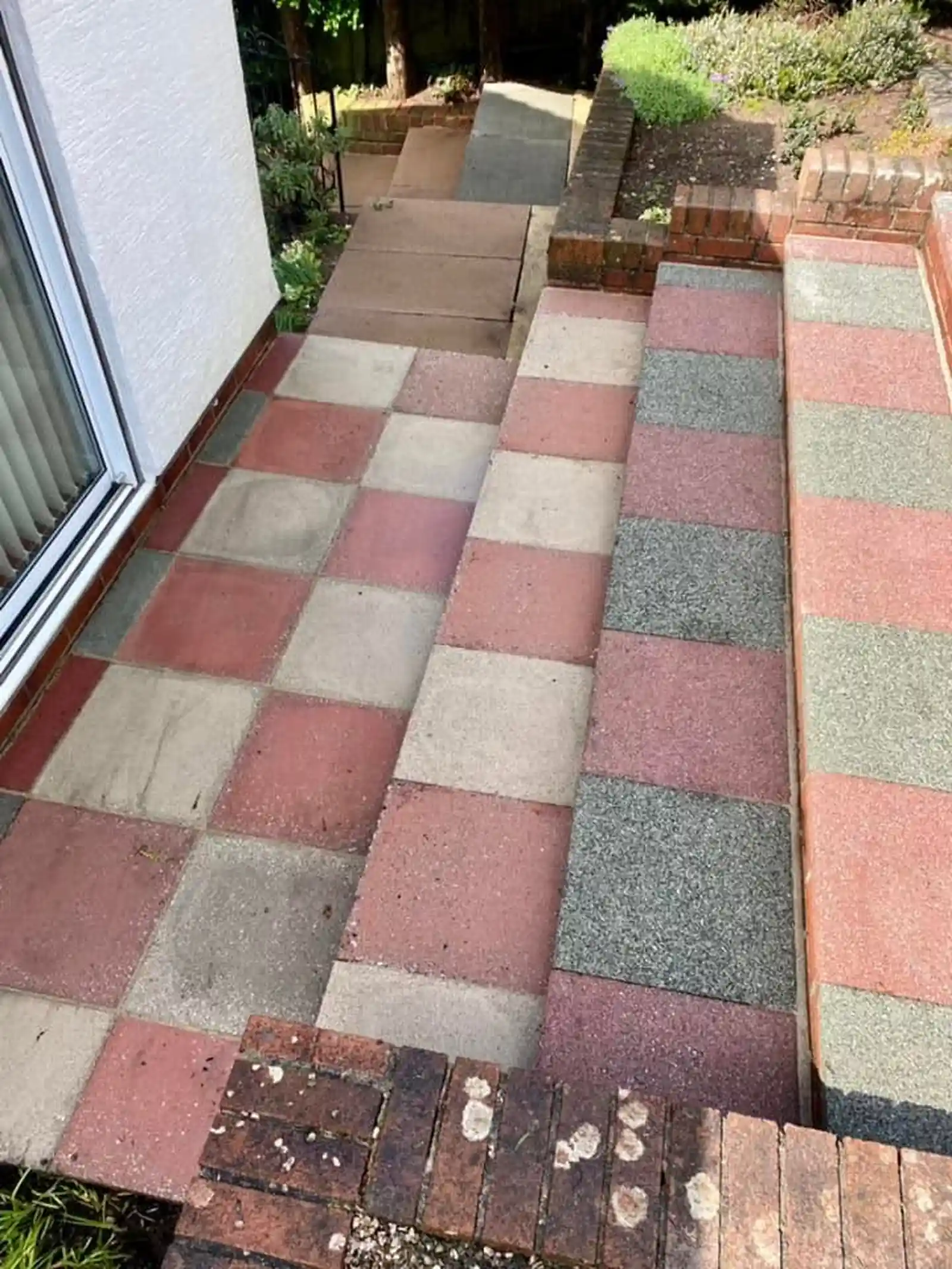
The result
Accepting natural variation across cleaned elevations
Cleaning can remove suitable dirt and growth while retaining the underlying material's character. It may reveal different colours between faces that have weathered differently, even when each has been cleaned appropriately. A uniform shade is not the test of a safe result. The final review looks for loose debris and discusses marks left in place because further removal would risk damage. Cleaning does not correct waterlogging, strengthen joints or prevent wind-blown material and fresh growth from returning.
Your appointment
Organising the visit between distinct outdoor areas
Allow for setup and material trials as well as washing time, particularly when the surfaces are spread around the property. If access depends on someone opening a gate or securing animals, agree this before the visit. Work may be sequenced so that one area is completed before equipment moves to another, but essential pedestrian use still needs planning. The drying of a sheltered step cannot be inferred from an exposed wall nearby, so the finished areas should be judged individually.
Before we visit
Getting gates, animals and water connections ready
Check that the intended entrance can be opened and tell us about locks, narrow gates or livestock near the route. Keep animals away from the working area and move small outdoor belongings where practical. Show us the outside water connection and mention any known supply limitations. Do not shift heavy items or disturb damaged masonry merely to make the site look ready. If the work crosses a shared path, arrange the necessary access discussion beforehand and explain when that route must be available.
Local conditions
Adapting work to changing moorland-edge conditions
Moorland-edge exposure can be relevant, but we make no assumption about wind or rainfall at a specific address. Gusts may prevent controlled spraying, rain can change runoff and low temperatures can make wet access unsafe. The forecast is checked alongside conditions on arrival, with work adjusted or rearranged if required. Even in a broadly dry spell, a protected recess may remain damp. Photographs of persistent wet patches help us understand where cleaning may not resolve the underlying issue.
Check your location
South Brent and the surrounding rural settlements
Coverage includes South Brent, Avonwick, Diptford, North Huish, Wrangaton, Moorhaven, Bittaford and Ugborough. For rural addresses, provide clear arrival directions and the relevant entrance. Village coverage does not remove the need to confirm access and surface suitability for each job.
- South Brent
- Avonwick
- Diptford
- North Huish
- Wrangaton
- Moorhaven
- Bittaford
- Ugborough
Common questions
Answers on mixed exposure and practical water supply
Should the exposed side and sheltered side be cleaned together?+
They can be assessed within the same visit, but they may not need identical treatment. Show both sides and explain your priorities. The scope can focus on areas where cleaning is worthwhile instead of applying one process everywhere simply for consistency.
What information helps with a rural water supply?+
Tell us where the usable connection is, whether access to it needs arranging and whether you know of supply restrictions or unreliable flow. Do not assume a distant or unfamiliar connection will be suitable. The practical requirements should be confirmed before equipment arrives.
Can cleaning stop the green strip returning beside my wall?+
It can reduce existing growth where the material tolerates the chosen method, but it cannot promise permanent prevention. Persistent shade, moisture and trapped debris can remain influential. If water regularly sits there, consider the cause separately rather than relying on repeated washing alone.
Based in Torquay? See our exterior cleaning in Torquay.
For garden and vehicle paving, see patio & driveway cleaning.
Google reviews
What SAS customers say
★★★★★ 80+ five-star reviews
★★★★★
“I had a badly stained patio he treated the whole patio and deep cleaned it with hot water and a patio cleaning machine I was very impressed patio looks like brand new 😎”
★★★★★
“A professional, effective, timely, courteous, friendly cleaning service, provided by Simon and his small team.”