
SAS Window Cleaning · Our work
Roof moss removal underway
- ✦ 30+ years' experience
- ✦ Fully insured
- ✦ 80+ 5★ reviews
- ✦ Free quotes
Get a free quote
Fast, friendly, no-obligation pricing.
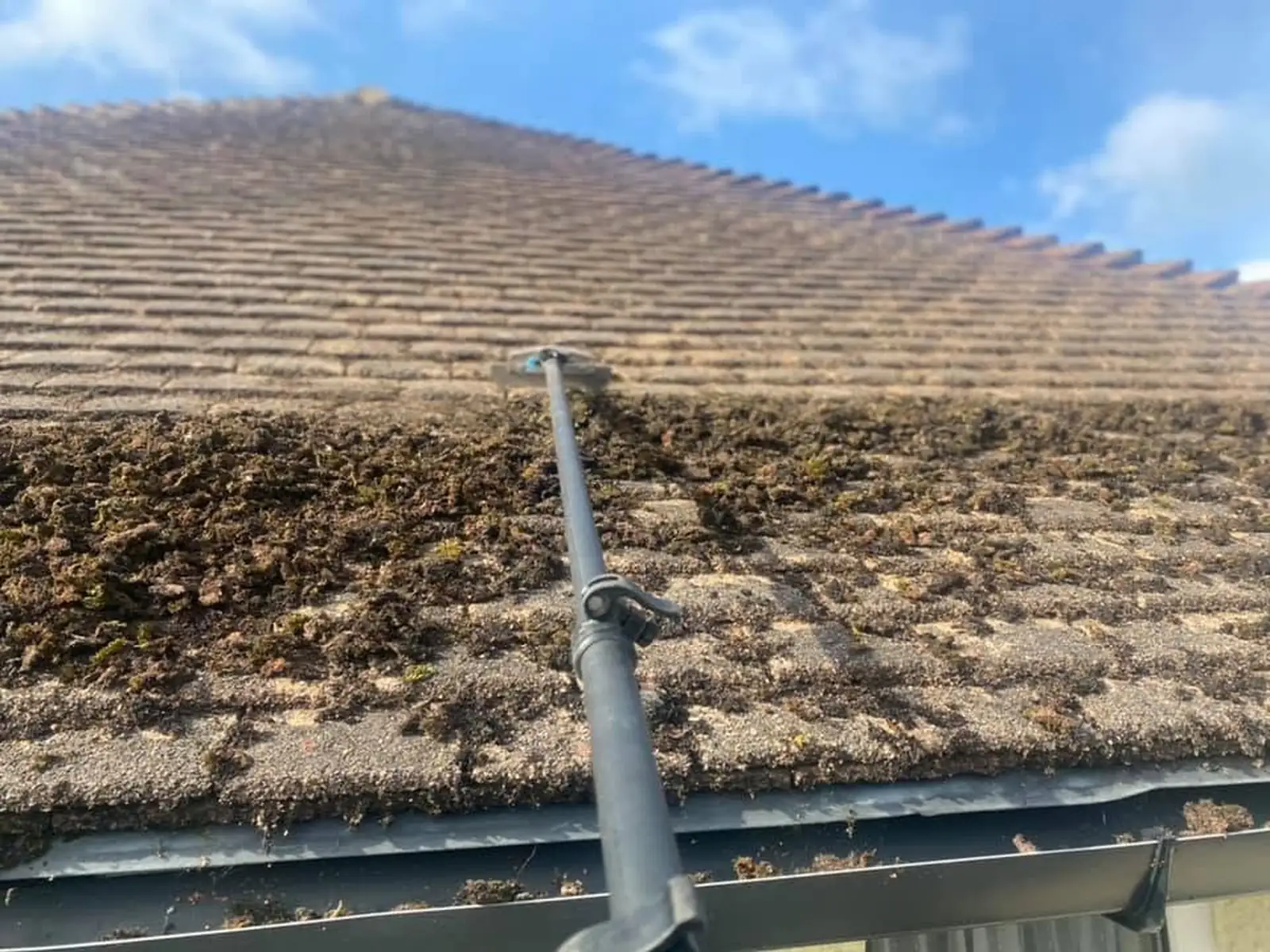
Heavy moss has built up between the lower rows of roof tiles close to the gutter. A pole-mounted tool is positioned on the slope as the growth is being addressed, recording an intermediate stage of roof work.
Moss removal requires attention to the tile profile and the condition of the covering. SAS usually considers controlled removal rather than high-pressure blasting, followed by an appropriate treatment when suitable and agreed. The gutter edge also needs consideration because loosened material can collect there during the work.
No finished condition or particular chemical treatment is claimed for this roof. Safe ground-level views and an access assessment are the right starting point for a similar enquiry. Cleaning does not repair broken tiles, and nobody should climb onto a roof to obtain closer views.
The surface
Thick moss accumulated between tiles near the gutter edge.
Our usual approach
Our usual moss-removal approach considers tile condition, careful mechanical removal and a suitable low-pressure follow-on treatment where agreed.
Visible condition
Work is underway on the moss-covered slope; a finished-roof result is not included.
Planning similar roof moss removal
The accompanying record captures moss removal underway and provides no evidence of a finished roof transformation. For a similar enquiry, an intermediate view is useful for understanding the maintenance concern, but it cannot establish the final condition, the full sequence of work or whether any subsequent treatment was applied after the photograph was taken.
Bulky growth near the eaves makes debris handling an important planning question alongside roof suitability. The covering, its profile and any known defects should be assessed before removal is proposed. Loose tiles, damaged mortar and signs of leakage may require a roofer first. Clearing growth is not equivalent to repairing the underlying material or proving it watertight.
Understanding methods and progress on similar roofs
Pole-mounted tools can allow some work to be approached from an appropriate position, but their presence does not establish that every part of a roof is reachable or suitable for scraping. Tool selection, contact force and visibility matter. A method must respect the covering rather than use heavier pressure whenever growth proves difficult to detach cleanly.
A follow-on treatment, if suitable, should be described and agreed separately rather than inferred from mechanical removal. Ask how nearby planting, rainwater collection and adjoining surfaces would be protected. The handling of loosened material also needs a clear plan so that moss is collected rather than left to obstruct the gutter or spread over lower roofs.
Preparing a similar moss-removal enquiry
Provide photographs from safe ground positions showing the affected slope, eaves and available access. Mention extensions, conservatories, overhead obstructions and any restrictions around the building. Include known roof repairs or leaks in the enquiry. Nobody needs to climb onto the covering or lean from an upper window to obtain close views for an initial discussion.
Ask whether the proposed scope includes gutter debris removal, waste collection and a review of any areas that cannot be reached. Tile repairs and leak investigation remain separate services unless expressly arranged. Discuss how completion will be assessed without expecting a uniformly new appearance. These points are guidance for comparable work, not claims about later stages of the pictured operation.
How we approach this type of job
Moss removal from roof tiles should be approached with care for the tile profile, condition and surrounding roof details. Growth between lower courses can loosen into the gutter area, so debris management matters. An in-progress view does not establish a finished result; agree the intended scope and any follow-on steps before work begins. A suitable plan may use controlled mechanical removal rather than high-pressure washing, with a low-pressure treatment considered where appropriate and agreed. Access must be safe, and damaged tiles or other defects need separate attention. The contractor should explain how loosened moss will be handled and whether gutter clearance is included. Cleaning will not repair broken tiles or guarantee a moss-free period.
Is your property similar?
Thick moss between tile courses, clumps collecting near the eaves, or debris appearing in gutters can indicate a roof needs assessment. Cracked tiles, loose fittings or leaks should be reported before discussing removal. Never climb onto the roof to inspect it; use ground-level views and mention access concerns. Ask us about a suitable approach and a free, no-obligation quote.